Aluminium is a toxic metal that in terms of global presence, occupies third place among all elements on the periodic table. We can safely say that we are surrounded by it. This is why we should learn to recognise its sources in order to protect ourselves, particularly children, who are particularly exposed to the negative effects of this element.
Concerned about aluminium exposure?
The first step is not detoxification. The first step is to determine whether elevated aluminium exposure is actually present and to assess the body’s overall mineral balance.
An Elemental Hair Analysis (HTMA) can help evaluate long-term mineral patterns and exposure to selected toxic elements.
👉 Learn more about HTMA
We have contact with aluminium every day and in almost every situation. Ways it gets into the body include the digestive tract due to contaminated food products, and skin penetration through cosmetics that we use every day. Its source may be kitchen pots (including enamelled ones – if they have been damaged, they're not safe) and canned drinks, which in the case of children, especially those with any diagnosed neurodevelopmental problem, must be completely eliminated.
WE'RE EXPOSED TO ALUMINIUM PARTICULARLY IN THE KITCHEN
Aluminium is found in tap water, evaporated salt, white sugar (sometimes bees refuse to consume such sugar), and even in baking powder and flour that we use in baking cookies for our children. Bread and pasta that we buy in stores are no better in this regard. It's worth realising the extent of the threat that lies in wait for us in products that are widely considered to be completely safe.
Have you ever wondered about a simple cheese sandwich that you put in your child's school bag for lunch? In addition to the bread in the sandwich, aluminium can also be found in the cheese, and if you wrap it in silver foil, such a snack definitely won't be healthy for a child. Rule number one: replace aluminium foil with sandwich paper. Avoid kitchen aluminium sources, pay attention to the products you cook and the equipment you use.
One of the worst and, unfortunately, the most-popular ways of preparing meals is heating them using aluminium foil. Using grill trays or wrapping roasted or grilled products in foil are very effective ways of delivering aluminium to the body. And what do we do with leftovers? Of course, we wrap them in foil and put them in the fridge. Another source of aluminium is juices and drinks in cartons lined with aluminium. Of course, manufacturers assure us that this doesn't affect our health, but if a carton of juice has been on a store shelf for six months, is it possible that harmful elements from the packaging haven't leached into it? Unfortunately, this isn't possible. Exactly the same thing happens with food and beverages packed in aluminium cans. Let's choose glass packaging as often as possible.
However, it's not just food wrapped in aluminium that contains this harmful toxin, making us less vigilant. Often, people whose diet consists mainly of white flour are surprised by the increased level of aluminium in their bodies. Not everyone realises that bread rolls and pasta can be such strong sources of this toxic element. This is particularly true for those sold in large stores produced from standardised flours, with added bleaches, which are a source of aluminium. So, let's choose pasta and bread from small producers. It's best if they are wholemeal, or milled once.
To check how much aluminium got into the body from kitchen utensils, water and food, it's worth doing an elemental hair analysis, which will give us the most accurate answer.
SOURCES OF ALUMINIUM IN YOUR BATHROOM
Aluminium gets into the body not only through the digestive system. It can also be absorbed through the skin. When we use shampoos, antiperspirants, lotions and deodorants, we rub aluminium into our skin. So, when shopping, we should pay attention to what we put into the trolley, especially when we're choosing cosmetics for children. Fortunately, we're currently observing an increase in awareness of the threat posed by aluminium. This is both among customers and cosmetics manufacturers.
ALUMINIUM AND MEDICATION
Aluminium can also get into a child's body through medication. A recent study showed that in children who were treated for hyperacidity for three months, the level of aluminium increased significantly. This metal is also found in vaccines, which have recently become an extremely sensitive and controversial topic, particularly among parents of children on the autism spectrum. However, let's try to take a closer look at them completely objectively, referring only to aluminium.
Why is aluminium added to vaccines? Unfortunately, without it, vaccines wouldn't make any sense, because aluminium is an adjuvant. It causes the antigens contained in vaccines to be detected by the cells. It's a "helper", or rather an amplifier without which the immune system wouldn't notice the viruses given in the vaccine.
The maximum daily amount of aluminium safe for a child has been determined to be 25mcg. However, vaccines contain much more. For the first year and a half, 4925mcg of aluminium gets into a child's body. This is, of course, variable, due to the variety of vaccines that are administered. However, the fact remains that large amounts of aluminium are given to children in vaccines.
In addition, it's not the amount of aluminium that's the biggest problem, but its form. Aluminium administered intramuscularly takes a different form to the one that is absorbed into the body from food. We're talking about aluminium hydroxide or aluminium phosphate in the form of nanoparticles, which are absorbed by macrophages into the brain. However, it should be noted that this process doesn't occur in all children, because the entry of macrophages into the brain is determined by factors that don't have to occur, and usually don't. We're obviously aware that there are incomparably more children who have been vaccinated and are healthy than those with vaccine-related complications.
As is clear from the above, not every child will develop vaccine complications, and vaccine administration is not synonymous with the occurrence of autism. There are cases of autistic siblings in which only one of the children was vaccinated. Linking vaccinations to autism is, therefore, creating a far-fetched correlation.
Unfortunately, the penetration of aluminium into brain tissue via macrophages is possible and does sometimes occur. The blood-brain barrier should theoretically block various molecules, including medications and toxins, but this isn't always the case. In reality, in children up to the age of one, this barrier is not sealed, which makes it possible for macrophages to introduce aluminium into the brain tissue. The problem with aluminium being transported to the brain via macrophages is exacerbated in children who have an overactive branch of the Th2 immune system. If aluminium gets into the brain, there is a chronic activation of glial cells. This causes inflammatory processes and increases the level of interleukin 6, which in turn causes disturbances in glutamate uptake. Glutamate receptors are activated, and cells that are activated often die. This is the problem in neurodegenerative diseases.
ALUMINIUM – MECHANISM OF OPERATION AND SYMPTOMS OF EXCESS
Aluminium is not a heavy metal, but it is a toxic metal. And like heavy metals and organic toxins, it disturbs the work of many enzymes. Children with mutations of single nucleotides, such as MTHFR 1298, CBS and NOS particularly have problems with detoxing aluminium.
Aluminium disturbs the work of the MTR enzyme (methyltransferase, which, with the participation of folic acid and vitamin B12, is involved in the recovery of methionine from homocysteine) and the DHPR enzyme. Both enzymes are essential for proper methylation. In addition, the DHPR enzyme is responsible for the recycling of BH4 biopterin into BH2; in other words, it's responsible for the production of serotonin and dopamine, which are neurohormones whose levels are very often low in children with neurodevelopmental problems. Excess aluminium can cause their inhibited production. An important role in the production of serotonin and dopamine is also played by ammonia, which should be detoxified by BH4. When the production of BH4 is blocked by aluminium, there is no way that the whole process can run properly. Excess aluminium blocking the production of enzymes also has a negative effect on the transport of oxygen and nutrients to the brain, which hinders normal speech development in children.
In addition to neurological problems, excess aluminium can make itself known in virtually every organ and system of the body. The most common symptoms include anaemia and other blood disorders, such as decreased levels of white blood cells. Young children may experience severe colic. Other typical symptoms include chronic fatigue, tooth decay, as well as thyroid, liver and kidney disorders, i.e. diminished detoxification.
Kryptopyrroluria (KPU), which is a haem metabolism disorder that many children suffer from, is also associated with excess aluminium. It's the same with all ulcers and amyotrophic lateral sclerosis. Parents often don't realise that there are many diseases related to excess aluminium.
Aluminium rarely acts alone
Children with elevated aluminium levels often present imbalances involving
magnesium, zinc, calcium, silicon or copper.
For this reason, evaluating
the overall mineral profile is usually more informative than looking at aluminium alone.
👉 Read about HTM A
HOW CAN YOU DIAGNOSE AND ELIMINATE EXCESS ALUMINIUM?
First, let's look at how the body gets rid of excess aluminium. It's believed that 99% of aluminium consumed in food is removed from the body in the faeces, and only 0.3% is absorbed into the blood, from which it's then removed by the kidneys. Unfortunately, this is just a very optimistic hypothesis. The whole process is actually very individual, and depends primarily on the proportion of nutrients in the given body. They're not permanent, and can vary from person to person. If they're present in appropriate amounts and proportions, mineral and vitamins have a positive effect on the proper production of enzymes and the process of detoxifying the body, eliminating the harmful effect of aluminium.
In the process of eliminating aluminium from the body, we must ensure the correct level of particularly those elements that are antagonistic to it. These include, for example, silicon. The ratio of zinc to copper is also very important. When it's correct, the body can effectively defend itself against the effects of this toxic element. Proteins called metallothioneins are responsible for this, and they require efficient methylation. In children who have methylation disorders (most children with autism and neurodevelopmental problems), metallothioneins don't work properly, and thus are unable to properly adjust the zinc to copper ratio. The correct ratio of these two elements enables the elimination of heavy metals and aluminium from the body.
The right amount of metallothioneins also determines the proper development of the immune system and the nervous system, as well as intestinal health. Metallothioneins also participate in the production of hydrochloric acid in the stomach, and affect the perception of the texture and taste of food. Many children with eating disorders have disturbed sensory integration and so don't perceive taste and texture correctly. This is related to, among other things, disturbed methylation and a lack of production of the right metallothioneins.
Studies carried out on hair samples to determine the correlation between mineral deficiencies and the body's toxic load showed a relationship between a deficiency in magnesium and zinc, and elevated levels of mercury and aluminium. Aluminium is infamously in first place among the toxic elements found in children's bodies. Various sources state that 17% of autistic children tested have a problem with excess aluminium in the body. In reality, this percentage can be estimated at 90%. This is backed by numerous studies carried out on hair samples of autistic children using the ICP-OES method (inductively coupled plasma optical emission spectrometry), carried out at the Lifeline Diag laboratory.
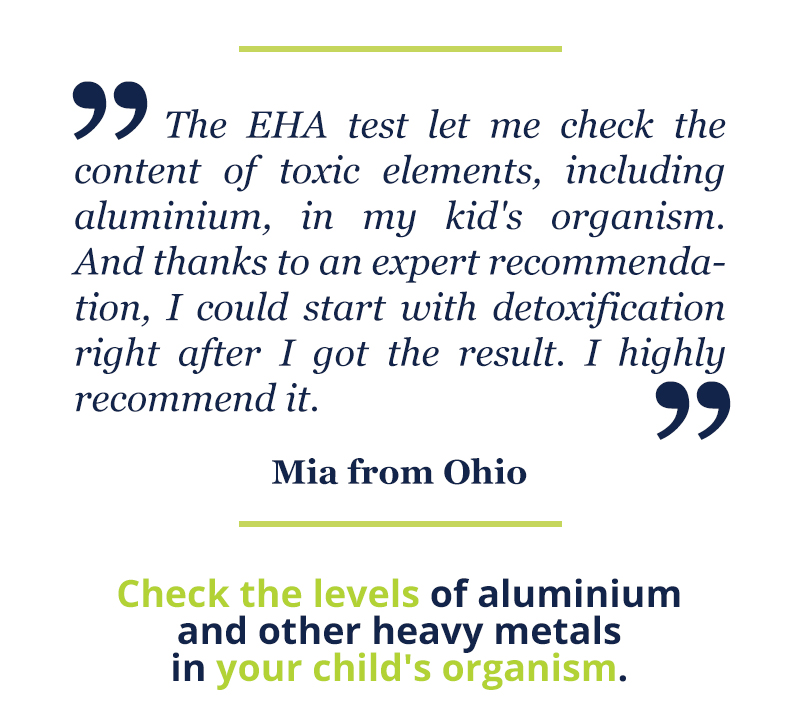
In autistic children, levels of zinc, magnesium and calcium are almost always lower than normal. To investigate the mineral deficiencies and the degree of the body's toxic load, including from aluminium, it's worth performing an
elemental hair analysis. EHA gives a lot more information than just data about the absence or presence of aluminium. If the result shows a type of metabolism that doesn't line up with the symptoms of the patient, it can be assumed that the cause of the disorder is an elevated level of heavy metals, usually mercury.
We can also check the concentration of toxic elements in the blood, but this method works better with acute poisoning. We can also perform a diagnostic test of urine or faeces after being exposed to detoxification, e.g. by administering high doses of zinc and selenium. After two or three days, you can check diagnostically whether toxic metals have started leaving the body. A diagnostic method used in the United States is also advanced metallothionein profile, where in addition to metallothioneins, the levels of zinc, copper and free copper, ceruloplasmin and glutathione are also tested. Only such advanced diagnostics can help define the problem.
In the case of significant excesses of toxic elements, supplementation is necessary to support the body in the process of detoxification and restoring its biochemical balance. Effective detoxifiers include B vitamins, zinc and silicon, magnesium malate (the clear leader in aluminium detoxification), spirulina, intestinal sorbents and products supporting detoxification containing extracts of asparagus officinalis root or yucca root. GABA products can also be used as an adjunct to balance the level of glutamate and to increase the amount of gamma-aminobutyric acid naturally present in the brain. At the same time, we need to be aware that detoxification won't be effective if we don't take a look at the digestive tract and overcome co-existing gut dysbiosis. Unfortunately, there's no panacea that'll get rid of aluminium on its own. We must approach many factors that enable effective detoxification together. First of all, we need to remove the source of exposure to heavy metals, and at the same time treat gut dysbiosis, which affects the modulation of the immune system. This'll improve digestion and the absorption of nutrients. Without a properly functioning gut, it'll be impossible to control inflammatory processes, including inflammatory processes in the brain, and reduce the MCP-1 molecule, which is a monocline that recruits macrophages to the brain, including those carrying aluminium.

Then, we must eliminate IgG and IgE-dependent allergens from the diet, and supplement it with detoxifying elements. We must also look after the liver, test histamine levels, perform a KPU test (if it's elevated, we can start to slowly administer vitamin B6, zinc and manganese), and a ceruloplasmin test and, of course, we must restore GABA balance. To remove aluminium from the body, we must remove organic toxins from the environment, including fungi and moulds that inhibit detoxification.
Effective detoxification of the body isn't possible without efficient methylation. Methylation is the transfer of methyl groups from one substance to another, for example, to activate its decomposition. For example, methyl groups are needed for the decomposition of histamine. If we have too few methyl groups, we can't efficiently decompose histamine. Therefore, the histamine level test can help us determine if we methylate well. If we have too little methyl, we have hypomethylation, and serum histamine levels increase; on the other hand, if we have too much methyl, we have hypermethylation, and histamine is usually below normal levels.
To effectively eliminate toxic elements from the body, we can' forget about proper supplementation. Malic acid, preferably in the form of magnesium malate, works very well for this purpose (plain malic acid also works, but has a slightly weaker effect). Magnesium malate has the ability to bind aluminium and remove it from the body. Magnesium fills the empty spots that were previously blocked by aluminium, which restores the proper functioning of many enzymes.
Before starting detoxification…
Before introducing supplements or detoxification protocols, it is worth assessing the body’s mineral status.
HTMA analyses:
✔ 29 elements
✔ toxic elements
✔ mineral ratios
✔ long-term mineral patterns
👉 Order HTMA
How can we improve methylation (in children and adults)?
- we need to supplement our daily diet with green leafy vegetables - they provide natural folates (a methyl group donor) necessary for proper methylation
- don't forget B vitamins
- support yourself with proper supplementation, paying particular attention to magnesium and zinc levels
- use probiotics - remember that good bacteria help produce and absorb B vitamins
- reduce stress and toxin exposure
- for adults, alcohol and smoking should be limited
Another supplement that we mustn't forget about is zinc. It effectively increases the amount of metallothioneins, which strengthens the body's defensive ability and reduces the absorption of aluminium. It's recommended to simultaneously use non-alcoholic coriander and chlorella extracts, as well as silicon supplementation, both in the form of intestinal sorbents and bamboo extract containing 70% of this element. Silicon, as an aluminium antagonist, effectively helps eliminate it from the body.
Aluminium detoxification requires us to provide a large amount of antioxidants. Curcumin conjugated with choline is great for this. Choline is crucial in rebuilding the cell membrane, and curcumin clears out free radicals. You can also use astaxanthin with choline or green tea extract. Quercetin also has the ability to scavenge free radicals. Glutathione function is strengthened very well by sulforaphane, which is a broccoli extract.
Detoxification, in other words – cleansing the body of unwanted toxins and heavy metals, is not easy and takes time. We all want what's best for our children, and for them to be healthy and develop properly in accordance with widely adopted norms. Sometimes, however, this doesn't happen. Thanks to perseverance, patience, and appropriate knowledge, we can do a lot.
What should you do next?
If you are concerned about your child’s exposure to aluminium:
Step 1
Reduce sources of exposure.
↓
Step 2
Assess long-term mineral status.
↓
Step 3
Consult an experienced practitioner.
↓
Step 4
Monitor changes over time.
Source
Anna Romaniuk, Jak usunąć aluminium: skuteczna diagnostyka i detoksykacja [How to remove aluminium: effective diagnostics and detoxification], DietPoint, 1(2)/2019, pp. 18-25.
We invite you to watch the video material.