


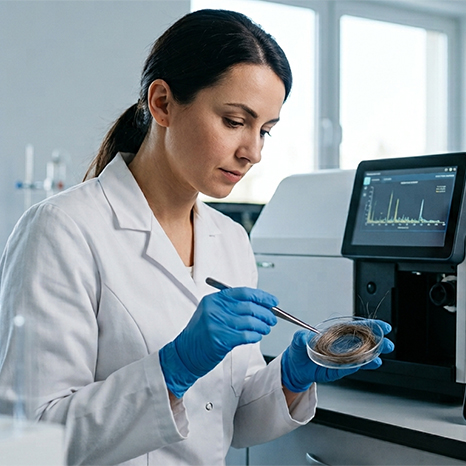
Hair Tissue Mineral Analysis (HTMA) provides information about the mineral composition of a hair sample, reflecting the period during which the analyzed hair grew. Since hair grows at an average rate of approximately 1 cm (0.4 inches) per month, repeating the test too frequently usually does not provide meaningful new information. In most cases, HTMA is best repeated every 3–6 months, depending on the purpose of monitoring.
Why Does the Frequency of HTMA Testing Matter?
Unlike blood tests, which provide a snapshot of your current physiological status, Hair Tissue Mineral Analysis reflects the period during which the analyzed section of hair was growing. Most laboratories analyze the first 1.5–3 cm (0.6–1.2 inches) of hair closest to the scalp, representing approximately the previous 6–12 weeks of hair growth. As a result, repeating the analysis only a few weeks later typically provides little additional information because the sample covers nearly the same growth period.
Your First HTMA Test
The initial Hair Tissue Mineral Analysis serves as a baseline for future comparisons. It can provide information about:
- the mineral composition of the hair sample,
- the relationships between selected minerals,
- long-term mineral trends,
- potential exposure to selected environmental elements.
The first HTMA report should not be interpreted as a medical diagnosis. Instead, it should be considered one component of a broader evaluation that includes lifestyle, nutrition, environmental exposure, and other relevant clinical information.
Read also: What Is Hair Tissue Mineral Analysis (HTMA)?
HTMA After Starting Supplementation
One of the most common reasons for repeating Hair Tissue Mineral Analysis is to monitor long-term changes after beginning a supplementation program. Because changes in mineral balance develop gradually, most practitioners recommend repeating the analysis after approximately 3–6 months. This interval allows long-term mineral trends to become visible rather than short-term fluctuations.
It is important to remember that HTMA is not designed to evaluate the effectiveness of an individual supplement, nor does it replace laboratory blood testing.
HTMA After Dietary Changes
Changes in dietary habits may also influence the mineral composition of hair over time. Repeating Hair Tissue Mineral Analysis after several months may be helpful for people who have:
- changed their overall dietary pattern,
- started an elimination diet,
- significantly increased the intake of specific foods,
- begun working with a registered dietitian or lifestyle medicine practitioner.
Any observed changes should always be interpreted in the context of the individual’s overall clinical picture and other available health information.
HTMA as a Lifestyle Monitoring Tool
An increasing number of people use Hair Tissue Mineral Analysis (HTMA) to monitor long-term lifestyle-related changes. This may include observing the effects of:
- overall dietary quality,
- physical activity levels,
- sleep quality,
- chronic stress,
- ongoing supplementation.
Comparing consecutive HTMA reports often provides more meaningful insights than interpreting a single result in isolation, as long-term trends can become easier to identify over time.
Related article: HTMA for Monitoring Supplementation and Lifestyle
Monitoring Environmental Exposure
Hair Tissue Mineral Analysis is also used in environmental biomonitoring. Repeat analyses may be beneficial for individuals who:
- work in industrial environments,
- are exposed to selected metals through their occupation or surroundings,
- have changed their place of residence or work environment,
- want to monitor long-term environmental exposure.
Results related to elements considered potentially toxic should always be interpreted with caution. Proper interpretation requires consideration of possible sample contamination, environmental factors, and additional clinical or laboratory information.
You may also be interested in: Can HTMA Detect Heavy Metals?
Why Doesn’t It Make Sense to Repeat HTMA Too Frequently?
Hair grows relatively slowly. If another HTMA test is performed only a few weeks after the previous one, the analyzed hair segment will represent nearly the same growth period. This may result in:
- only minor differences between reports,
- more difficult interpretation,
- unnecessary testing costs,
- the incorrect impression that no meaningful changes have occurred.
For this reason, allowing sufficient time between analyses is generally recommended to obtain more informative long-term comparisons.
How Often Should You Repeat HTMA?
The table below provides general recommendations for repeat testing intervals.
| Purpose of Testing | Recommended Interval |
| Initial HTMA analysis | At any time |
| Monitoring supplementation | Approximately every 3–6 months |
| Monitoring dietary changes | Approximately every 3–6 months |
| Lifestyle monitoring | Approximately every 6 months |
| Environmental biomonitoring | Individualized, depending on the monitoring objective |
The optimal frequency of Hair Tissue Mineral Analysis should always be determined by your individual circumstances and the specific purpose of testing.
Interested in Getting a Hair Mineral Analysis?
If you would like to evaluate your long-term mineral status after reading this article:
– collect your own hair sample at home
– your sample is analyzed using the ICP-OES method
– receive a comprehensive report describing mineral levels and mineral balance
How often should you repeat a Hair Tissue Mineral Analysis (HTMA)?
Can you have an HTMA every month?
When should I repeat HTMA after starting supplements?
Can HTMA be used to monitor lifestyle changes?
Does HTMA replace blood tests?
Is it useful to compare consecutive HTMA reports?
Hair Tissue Mineral Analysis (HTMA) is most valuable as a tool for monitoring long-term mineral trends. Because the analyzed section of hair represents several weeks or months of growth, repeating the analysis too frequently rarely increases its clinical or informational value. For most individuals, an interval of approximately 3–6 months between tests is appropriate. However, the optimal testing frequency should always reflect the purpose of the analysis, lifestyle changes, and individual circumstances.
Read also
- What Is Hair Tissue Mineral Analysis (HTMA)? A Complete Guide
- HTMA for Monitoring Supplementation and Lifestyle
- Does HTMA detect heavy metals?
- Why can HTMA and blood tests show different results?
References
- Kempson IM, Lombi E. Hair analysis as a biomonitor for toxicology, disease and health status. Chemical Society Reviews. 2011;40(7):3915–3940.
- Rodrigues JL, Batista BL, Nunes JA, Passos CJ, Barbosa F Jr. Evaluation of the use of human hair for biomonitoring the deficiency of essential and exposure to toxic elements. Science of the Total Environment. 2008;405(1–3):370–376.
- Bass DA, Hickock D, Quig D, Urek K. Trace element analysis in hair: Factors determining accuracy, precision, and reliability. Biological Trace Element Research. 2001;83(1):1–16.
- Seidel S, Kreutzer R, Smith D, McNeel S, Gilliss D. Assessment of commercial laboratories performing hair mineral analysis. JAMA. 2001;285(1):67–72.
- World Health Organization (WHO). Human Biomonitoring: Facts and Figures.
- International Atomic Energy Agency (IAEA). Elemental Analysis of Biological Materials: Current Problems and Techniques with Special Reference to Trace Elements.
Hair Tissue Mineral Analysis (HTMA) is a biomonitoring tool used to evaluate long-term mineral trends and potential environmental exposure. It is not a diagnostic medical test and should not be used as a substitute for professional medical advice, diagnosis, laboratory testing, or treatment.
